What Do CCPA and CPRA Mean for Growing Businesses?
On This Page
- CCPA and CPRA are California's privacy laws
- Three thresholds generally bring a business into scope
- CPRA expanded the original law
- The rights CCPA and CPRA give California consumers
- Businesses in scope take on specific responsibilities
- What changed for 2026
- CCPA and CPRA are not the same as GDPR
- Where founders usually want counsel
- Frequently Asked Questions
CCPA and CPRA are California's privacy laws
The CCPA took effect on January 1, 2020, and was the first comprehensive consumer privacy law in the United States. The CPRA, passed by California voters later that year, amended the CCPA rather than replacing it, adding new rights and obligations that took full effect in 2023. The CPRA also created the California Privacy Protection Agency (CPPA), an independent regulator with authority to write rules, issue guidance, and enforce the law. When people refer to "CCPA" today, they usually mean the combined law as amended by the CPRA.
Three thresholds generally bring a business into scope
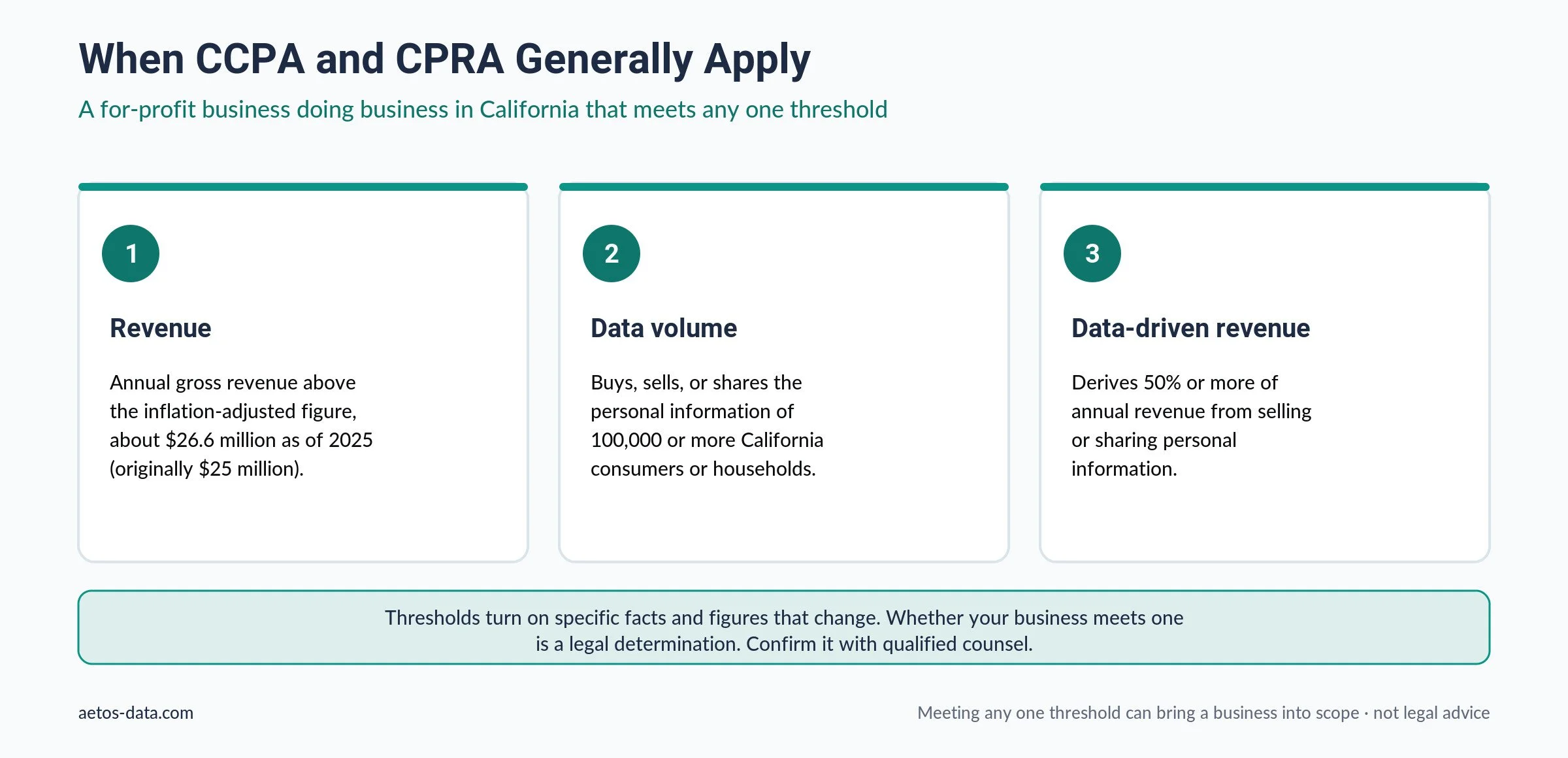
The law does not apply to every company that touches a Californian's data. It generally reaches a for-profit business that does business in California and meets at least one of three thresholds:
- Revenue — annual gross revenue above the inflation-adjusted figure, which is about $26.6 million as of 2025 and was originally $25 million
- Data volume — buying, selling, or sharing the personal information of 100,000 or more California consumers or households in a year
- Revenue from data — deriving 50% or more of annual revenue from selling or sharing personal information
Because these thresholds turn on specific facts and figures that change, whether a given business meets one is a determination we recommend confirming with qualified counsel.
CPRA expanded the original law
The CPRA did more than refresh the CCPA. It introduced a category of "sensitive personal information," covering data such as precise geolocation, financial details, and health information, and gave consumers the right to limit how it is used. It added a right to correct inaccurate information. It also introduced the concept of "sharing" personal information for cross-context behavioral advertising, which matters because the right to opt out now covers sharing, not only selling. For founders, the practical effect is that more data and more activities fall within the law's reach than under the original CCPA.
The rights CCPA and CPRA give California consumers
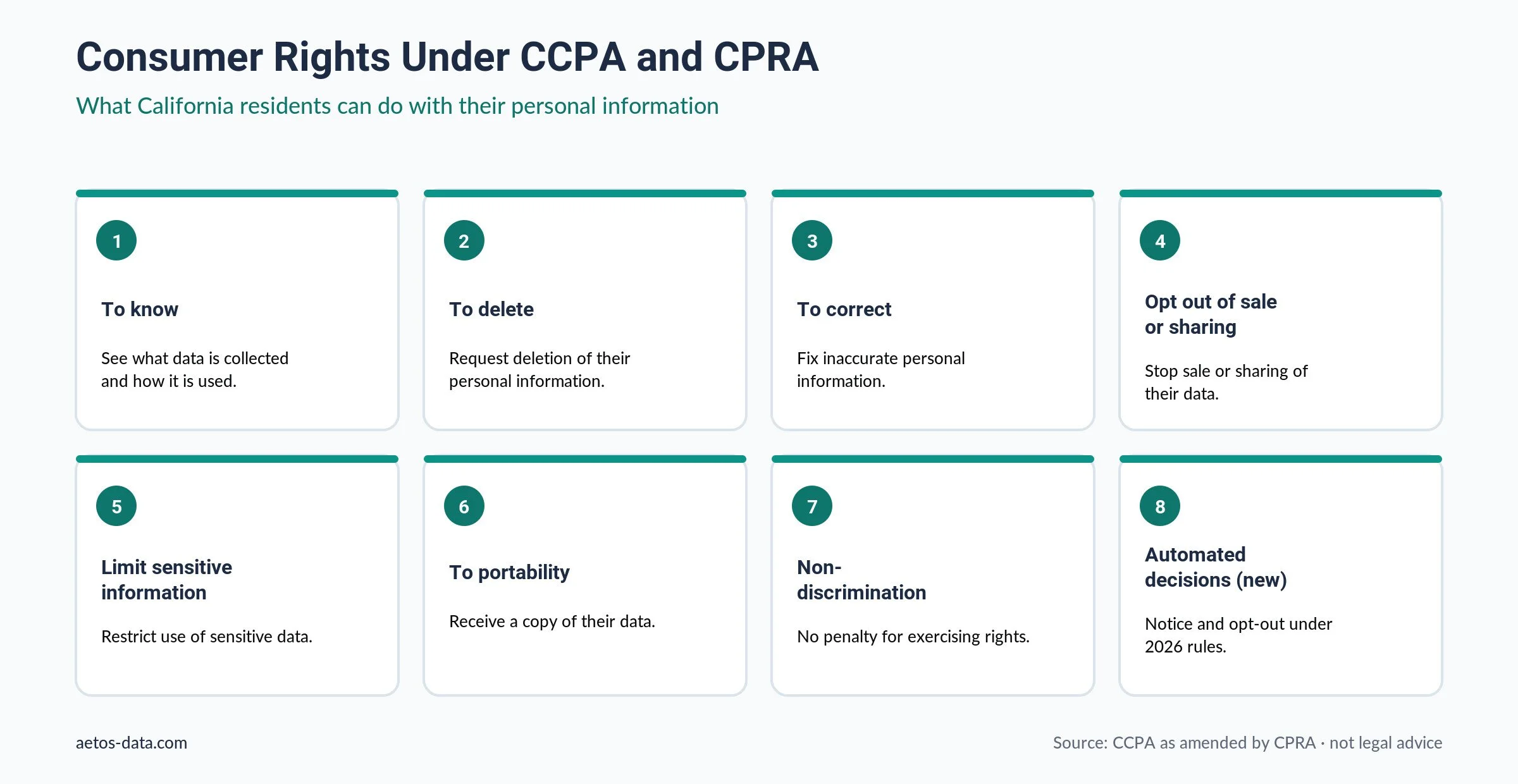
The heart of the law is a set of rights for California residents. These include:
- The right to know what personal information a business collects and how it is used
- The right to delete personal information
- The right to correct inaccurate information
- The right to opt out of the sale or sharing of personal information
- The right to limit the use of sensitive personal information
- The right to data portability
- The right to non-discrimination for exercising any of these rights
Businesses in scope are expected to have clear ways for consumers to make these requests and to honor them within the law's timeframes.
Businesses in scope take on specific responsibilities
Alongside consumer rights, the law sets expectations for covered businesses. In general terms, these include:
- Providing clear privacy notices that explain what is collected and why
- Honoring opt-out requests, including opt-out preference signals such as the Global Privacy Control
- Putting contracts in place with the service providers and third parties that handle data on a business's behalf
- Collecting only the data reasonably necessary for a disclosed purpose
- Maintaining reasonable security
The specifics of how these apply depend on the business, which is one reason a documented program matters.
What changed for 2026
The CPPA finalized a significant set of regulations that took effect on January 1, 2026, and they broaden what businesses in scope are expected to do. In general terms, the rules address:
- Automated decision-making technology — businesses that use it for significant decisions must provide notice, an opt-out, and explain the logic on request
- Risk assessments for higher-risk processing, such as handling sensitive information at scale
- Cybersecurity audits for businesses that meet certain thresholds
These requirements phase in over time, and how they apply to a particular business is a point we recommend reviewing with qualified counsel.
CCPA and CPRA are not the same as GDPR
Founders often ask whether complying with one covers the other. They share goals, but they differ in important ways. GDPR is the European Union's regulation and applies broadly to the personal data of people in the EU, while CCPA and CPRA are California laws built around consumer rights and specific business thresholds. A program built for one provides a strong foundation for the other, but it does not automatically satisfy it. We compare the broader landscape in our guide to GDPR for US startups.
Where founders usually want counsel
Several questions here are legal determinations rather than operational ones. Whether your business meets a threshold, whether a particular data flow counts as a "sale" or "sharing," whether the new automated decision-making, risk assessment, or cybersecurity audit rules reach you, and how to interpret the CPPA's regulations all depend on your specific facts. Aetos helps companies build the privacy program and documentation that support compliance, working alongside your legal counsel rather than in place of them on these questions.
Frequently Asked Questions
Where to go from here
A useful first step is understanding what personal information you collect, where it comes from, and who you share it with — that clarifies most of the analysis before any legal review. For more, see our explainers on the core US data privacy principles, when to review and update your privacy policies, and GDPR for US startups.
This article provides general information about the CCPA and CPRA and is not legal advice. Aetos Data Consulting is not a law firm and does not provide legal advice. Whether these laws apply to your business, and how, depends on your specific facts. For a determination and for help meeting any legal obligations, consult qualified legal counsel.