What Is SOC 2? Type I vs. Type II, Explained

SOC 2 is a voluntary reporting framework, created by the American Institute of Certified Public Accountants (AICPA), that shows how a company protects customer data. An independent auditor examines your security controls against a set of criteria and issues a report. A Type I report describes whether your controls are well designed at a single point in time. A Type II report goes further and tests whether those controls actually operated effectively across a period, usually three to six months. Enterprise buyers ask for it because it gives them evidence they can trust.

What does SOC 2 actually show? - An Independent Report on How You Protect Customer Data

SOC 2 stands for System and Organization Controls 2. It is the way a service company — most often a software-as-a-service (SaaS) or cloud business — demonstrates that the systems holding customer data are well run. Rather than asking buyers to take your word, you engage a licensed certified public accountant (CPA) firm to examine your controls and publish an independent report. That report becomes the artifact your prospects, their security teams, and their procurement reviewers rely on when they decide whether to trust you with their data.

SOC 2 stands for System and Organization Controls 2. It is the way a service company, most often a SaaS or cloud business, demonstrates that the systems holding customer data are well run. Rather than asking buyers to take your word, you engage a licensed CPA firm to examine your controls and publish an independent report. That report becomes the artifact your prospects, their security teams, and their procurement reviewers rely on when they decide whether to trust you with their data.

What are the five Trust Services Criteria? - Scope What You Are Evaluated On

SOC 2 is built on five Trust Services Criteria, and you choose which ones fit your business. Security, often called the common criteria, is required in every report. The other four are optional: Availability covers uptime and resilience; Processing Integrity covers whether systems deliver accurate results; Confidentiality covers protecting sensitive information; and Privacy covers how personal data is collected and used. Most companies start with Security alone, then add criteria as customer commitments grow. Scoping these well keeps the report relevant and the effort proportional.
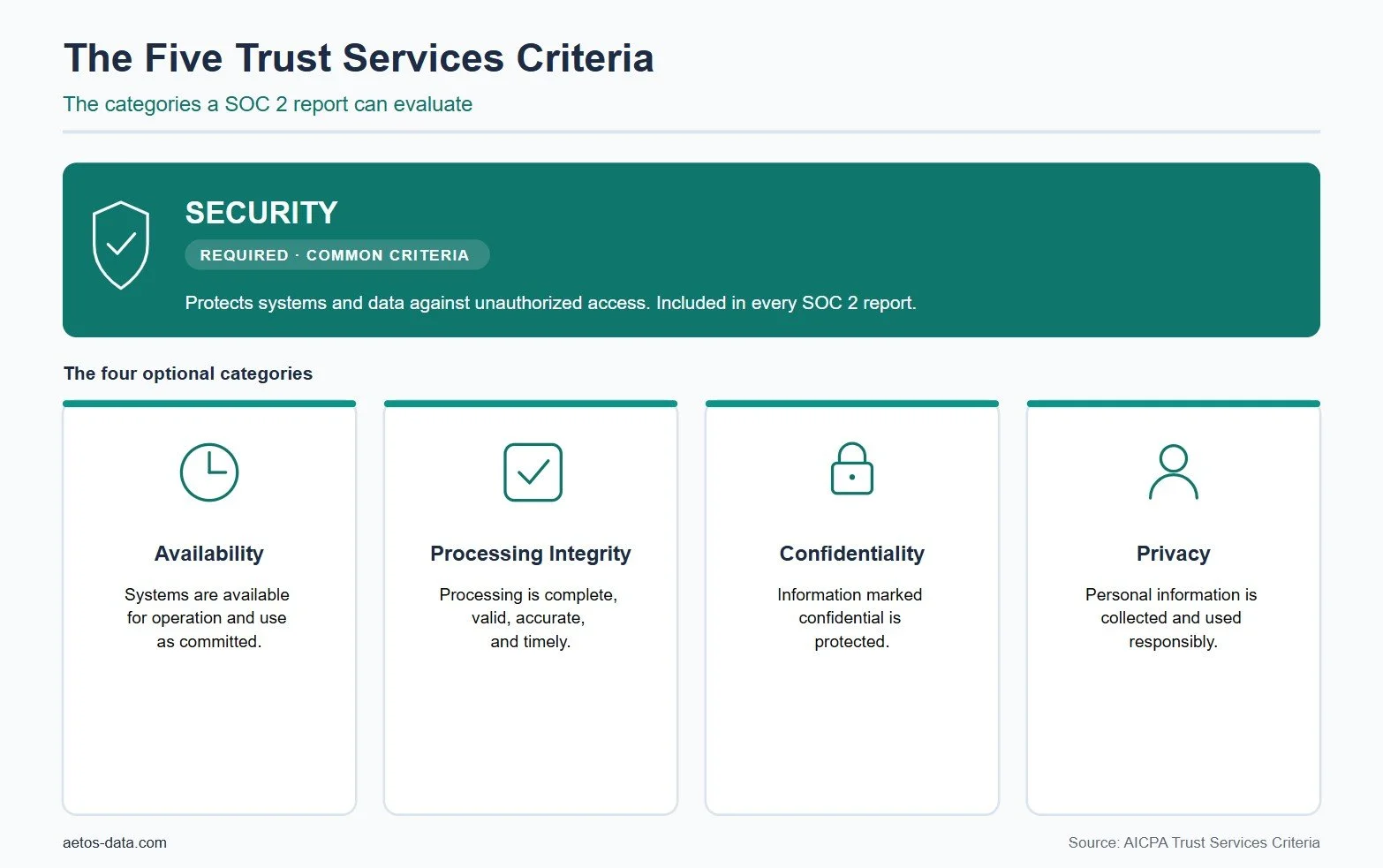
SOC 2 is built on five Trust Services Criteria, and you choose which ones fit your business. Security, often called the common criteria, is required in every report. The other four are optional:

  • Availability — uptime and resilience
  • Processing Integrity — whether systems deliver accurate results
  • Confidentiality — protecting sensitive information
  • Privacy — how personal data is collected and used

Most companies start with Security alone, then add criteria as customer commitments grow. Scoping these well keeps the report relevant and the effort proportional.

The five Trust Services Criteria: Security, Availability, Processing Integrity, Confidentiality, and Privacy.

What is the difference between Type I and Type II? - Design at a Moment vs. Performance Over Time

A Type I report is a snapshot. It confirms that, on a specific date, your controls were designed appropriately. A Type II report is a track record. It confirms that your controls operated effectively throughout an observation window, typically three to six months. Type I answers "are the right controls in place," while Type II answers "do those controls actually work, day after day." Type II carries more weight precisely because it is harder to earn.

This is the distinction buyers care about most. A Type I report is a snapshot. It confirms that, on a specific date, your controls were designed appropriately. A Type II report is a track record. It confirms that your controls operated effectively throughout an observation window, typically three to six months.

SOC 2 Type I SOC 2 Type II
What it shows Control design at a point in time Control design and operation over a period
Time frame A single date Usually three to six months
Effort Lower Higher
Buyer confidence Moderate High
Common use A first step or interim proof The report most enterprises expect

What do enterprise buyers expect? - Type II Is the Standard, Not the Exception

If your goal is to close enterprise deals, plan for Type II. Many security teams accept a Type I report as interim evidence, especially from a younger company, but they often expect a Type II to follow within the year. A practical path is to earn Type I first to show momentum, then run the observation window and produce Type II. Leading with the report buyers actually expect keeps your security posture from becoming a sticking point in the sales cycle.

If your goal is to close enterprise deals, plan for Type II. Many security teams accept a Type I report as interim evidence, especially from a younger company, but they often expect a Type II to follow within the year. A practical path is to earn Type I first to show momentum, then run the observation window and produce Type II. Leading with the report buyers actually expect keeps your security posture from becoming a sticking point in the sales cycle.

What does a SOC 2 report contain? - Four Sections Every Prospect Wants to Review

A SOC 2 report contains four parts: the independent auditor's opinion, which is the headline conclusion; management's assertion, which is your formal statement about your system; the system description, which explains your services, infrastructure, and controls; and the tests of controls with results, which is the detailed evidence for a Type II. When a prospect asks for "the SOC 2," this full report is what they mean.

Knowing the structure helps you read your own report and answer buyer questions with confidence. A SOC 2 report contains:

  • The independent auditor's opinion — the headline conclusion
  • Management's assertion — your formal statement about your system
  • The system description — explains your services, infrastructure, and controls
  • Tests of controls with results — the detailed evidence, included in a Type II

When a prospect asks for "the SOC 2," this full report is what they mean.

How long does SOC 2 readiness take? - Eight to Twelve Weeks with the Right Guidance

For most growing SaaS companies, getting audit-ready takes about 8 to 12 weeks with the right guidance, though the timeline depends on how mature your controls already are. Readiness work usually means selecting your criteria, documenting policies, closing gaps in areas like access control and monitoring, and gathering the evidence an auditor will test. For a Type II, you then add the observation window before the auditor completes fieldwork. Planning the sequence early keeps the process predictable and avoids last-minute scrambling before a deal.

For most growing SaaS companies, getting audit-ready takes about 8 to 12 weeks with the right guidance, though the timeline depends on how mature your controls already are. Readiness work usually means selecting your criteria, documenting policies, closing gaps in areas like access control and monitoring, and gathering the evidence an auditor will test. For a Type II, you then add the observation window before the auditor completes fieldwork. Planning the sequence early keeps the process predictable and avoids last-minute scrambling before a deal.

Is SOC 2 a legal requirement? - A Commercial Credential, Not a Regulatory Mandate

SOC 2 is a framework and an attestation, not a legal requirement and not a certification. No statute compels SOC 2, and an auditor issues a report rather than a certificate. What drives adoption is the market: enterprise buyers, partners, and investors increasingly treat a clean SOC 2 report as the price of entry. That makes it less a regulatory obligation and more a commercial credential — one that signals you handle data responsibly.

It helps to be precise about what SOC 2 is. It is a framework and an attestation, not a legal requirement and not a certification. No statute compels SOC 2, and an auditor issues a report rather than a certificate. What drives adoption is the market: enterprise buyers, partners, and investors increasingly treat a clean SOC 2 report as the price of entry. That makes it less a regulatory obligation and more a commercial credential, one that signals you handle data responsibly.

How does SOC 2 help close enterprise deals? - A Sales Asset, Not Just a Security Exercise

A SOC 2 report is a sales asset. When a prospect's security team can review your report instead of sending a 200-line questionnaire, reviews move faster and deals stall less often. A strong report tells enterprise buyers you are ready to handle their data, and that readiness becomes a differentiator against competitors who cannot show the same. Trust, demonstrated clearly, is what moves an enterprise deal across the finish line.

Here is the part founders tend to underestimate. A SOC 2 report is a sales asset, not just a security exercise. When a prospect's security team can review your report instead of sending a 200-line questionnaire, reviews move faster and deals stall less often. A strong report tells enterprise buyers you are ready to handle their data, and that readiness becomes a differentiator against competitors who cannot show the same. Trust, demonstrated clearly, is what moves an enterprise deal across the finish line.

Frequently Asked Questions

Q: Is SOC 2 a certification?
A: No. SOC 2 results in an attestation report issued by a licensed CPA firm, not a certificate or a pass-or-fail badge. The value lives in the report itself, including the auditor's opinion and, for a Type II, the detailed test results.
Q: How long is a SOC 2 report valid?
A: A report covers a stated period and is generally treated as current for about 12 months. Many companies produce a new Type II each year and use a bridge letter to cover the gap between their report date and a buyer's review.
Q: What is the difference between SOC 2 and ISO 27001?
A: Both demonstrate strong security, but SOC 2 is an attestation report based on the Trust Services Criteria, while ISO 27001 is an international standard that certifies an information security management system (ISMS). We cover how to choose between them in a dedicated article.
Q: How much does a SOC 2 audit cost?
A: Costs vary with scope, the criteria you include, and whether you pursue Type I or Type II. We break down the ranges and the timeline in a separate guide so you can budget with realistic numbers.
Q: Do early-stage startups need SOC 2?
A: Not always on day one. The right moment is usually when enterprise prospects begin asking for it or when it is blocking deals. Starting readiness before that point means you are prepared when the first serious buyer asks.

If enterprise buyers are starting to ask about your security posture, the most useful next step is to understand where you stand and what your market actually expects. To go deeper on the surrounding topics, see our guides on demonstrating a strong security posture and preparing for a cybersecurity audit.

Shayne Adler

Shayne Adler is the co-founder and Chief Executive Officer (CEO) of Aetos Data Consulting, specializing in cybersecurity due diligence and operationalizing regulatory and compliance frameworks for startups and small and midsize businesses (SMBs). With over 25 years of experience across nonprofit operations and strategic management, Shayne holds a Juris Doctor (JD) and a Master of Business Administration (MBA) and studied at Columbia University, the University of Michigan, and the University of California. Her work focuses on building scalable compliance and security governance programs that protect market value and satisfy investor and partner scrutiny.

Connect with Shayne on LinkedIn

https://www.aetos-data.com
Next
Next

How to Answer the AI Governance Section of a Security Questionnaire