SOC 2 vs. ISO 27001: Which Does Your Startup Need?
- How SOC 2 and ISO 27001 differ as proof of security
- Why attestation and certification are fundamentally different outcomes
- Why geography often settles the question
- How the two overlap and why doing both is common
- How to choose based on what your buyers actually ask for
- Frequently asked questions: ISO 27001 vs. SOC 2 for startups
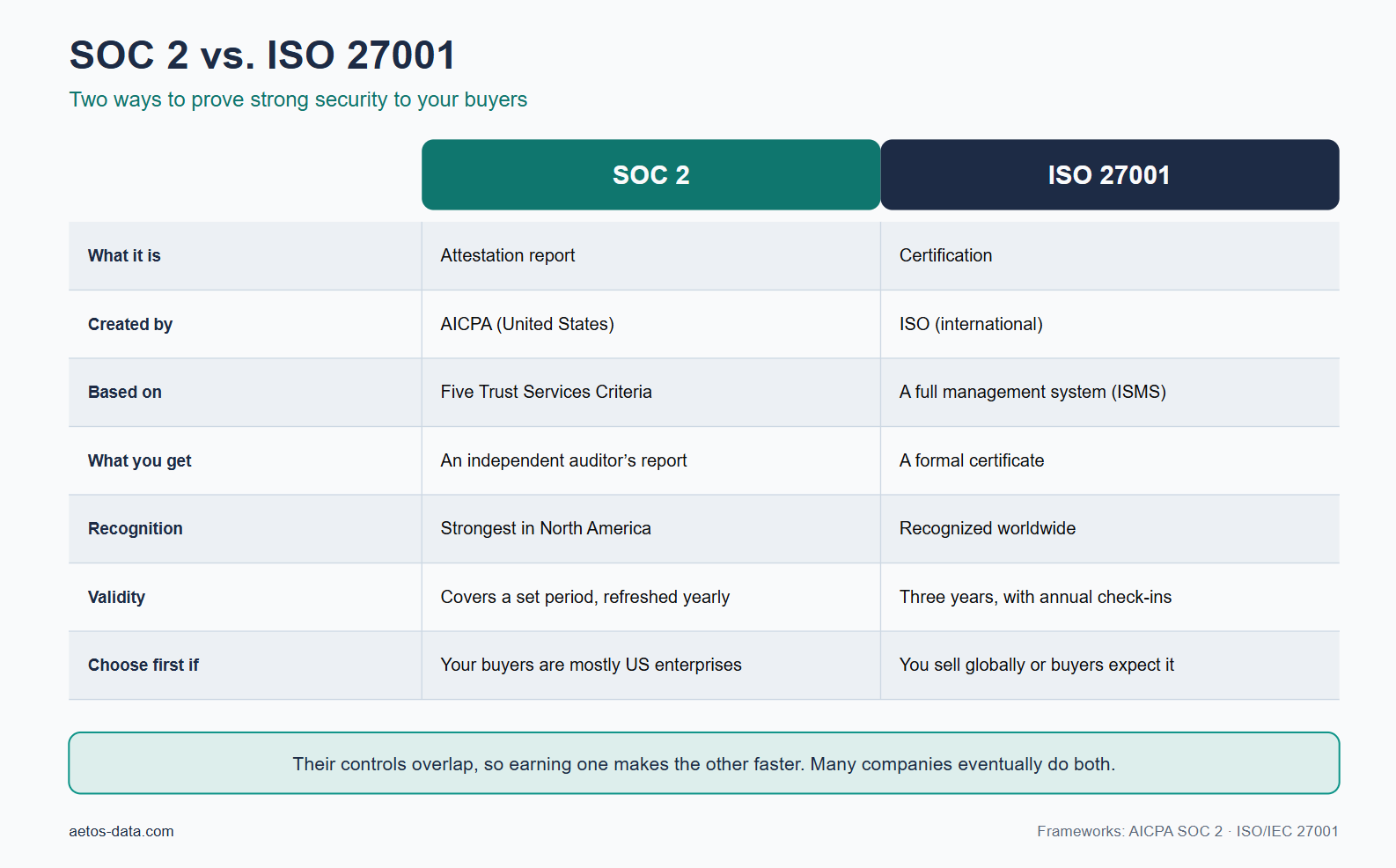
Both SOC 2 and ISO 27001 prove that you manage customer data responsibly, but they speak to different audiences. SOC 2 is a US-centric attestation report, built on the American Institute of Certified Public Accountants (AICPA) Trust Services Criteria, in which an auditor reports on how your controls operate. ISO 27001 is an internationally recognized certification of an information security management system, or ISMS. As a rule of thumb, choose SOC 2 if your buyers are mostly North American enterprises, and ISO 27001 if you sell internationally or your buyers expect it. Many companies eventually pursue both.
SOC 2 and ISO 27001 both prove security, in different languages
The two frameworks aim at the same outcome: giving a buyer confidence that you protect their data. They simply express it differently. SOC 2 produces a detailed report an auditor writes about your environment, which buyers read closely. ISO 27001 produces a certificate confirming you run a recognized security management system. Neither is inherently better. The right choice depends on who your buyers are, where they operate, and what they have come to expect from vendors like you.
SOC 2 is an attestation report; ISO 27001 is a certification
This is the core difference. SOC 2 results in an attestation: a licensed CPA firm examines your controls and issues a report with its opinion and, for a Type II, detailed test results. There is no certificate and no pass-or-fail badge. ISO 27001 results in certification: an accredited body audits your management system and, if you meet the standard, issues a certificate. One gives buyers a report to study, the other gives them a credential to verify.
SOC 2 is built on five criteria; ISO 27001 is built on a management system
SOC 2 evaluates your controls against the five Trust Services Criteria, with Security required and Availability, Processing Integrity, Confidentiality, and Privacy added as your commitments grow. ISO 27001 takes a wider lens. It certifies that you operate an information security management system, meaning a documented, repeatable program for identifying risks, applying controls, and improving over time. SOC 2 asks whether your controls work. ISO 27001 asks whether you run a disciplined system that keeps them working.
Geography often decides the first move
For most startups, the buyer's location settles the question. SOC 2 originated in the United States and carries the most weight with North American enterprises, which is why US-focused software-as-a-service (SaaS) companies usually start there. ISO 27001 is recognized worldwide and is frequently the default expectation among European, Asian, and other international buyers. If your pipeline is concentrated in one region, follow it. If a specific deal hinges on one framework, let that deal lead.
The two overlap more than they compete
These frameworks are not rivals so much as different views of the same security program. Their control sets overlap substantially, so the evidence you gather for one carries over to the other. A company that earns SOC 2 has already done much of the work ISO 27001 requires, and the reverse is true as well. That overlap is why pursuing both is far less than twice the effort, and why teams often sequence them rather than choosing permanently.
Cost and timeline differ in shape
The investment differs in pattern more than in size. A SOC 2 Type II involves readiness work and an observation window, usually three to six months, after which the auditor reports. ISO 27001 involves building and documenting the management system, then a two-stage certification audit, with the certificate valid for three years and annual surveillance audits in between. SOC 2 tends to recur yearly; ISO 27001 runs on a three-year cycle. We cover specific budgets in our SOC 2 cost guide.
How to choose: let your buyers decide
The cleanest decision rule is to follow demand. If enterprise prospects are asking for "your SOC 2," start with SOC 2. If deals stall because a buyer wants ISO 27001, start there. If you are pre-revenue and no one is asking yet, SOC 2 is usually the more efficient first step for a US-based startup, and it positions you well for ISO 27001 later. The goal is to remove a trust barrier from a real deal, not to collect credentials for their own sake.
Doing both is common as you scale
As companies grow into multiple markets, holding both becomes normal rather than redundant. A SOC 2 report satisfies North American security teams who want to read the detail, while an ISO 27001 certificate satisfies international buyers and partners who recognize the standard. Because the underlying controls are shared, maintaining both is mostly a matter of aligning evidence and audit calendars. For a global sales motion, the pair signals maturity that neither framework fully conveys on its own.
Frequently asked questions
Where to go from here
If you are weighing this decision, start by clarifying what your current and target buyers expect, then sequence accordingly. For background, see our explainer on what SOC 2 is and the difference between Type I and Type II, and our guides on building an agile compliance framework for rapid market entry and navigating compliance for early-stage startups.
Not sure which path fits your buyers? Talk to a trust advisor and we will help you choose the framework that unblocks your next deal.