How Much Is a SOC 2 Audit and How Long Does It Take?
On This Page
- The four cost buckets
- Why Type II costs more than Type I
- A realistic first-year breakdown
- What drives the price up
- How long it takes
- Budget your team's hours, not just the dollars
- Does cost drop in year two?
- How to keep the investment right-sized
- The return: unblocked deals
- Frequently Asked Questions
SOC 2 costs fall into four buckets
It helps to see the full picture rather than just the audit invoice. A SOC 2 budget has four parts:
- The auditor's fee — what the licensed CPA firm charges to examine your controls and issue the report
- A readiness assessment — identifies gaps before the formal audit begins
- A compliance automation platform — collects evidence and monitors controls continuously
- Internal time and remediation — the work your team does to close gaps
Founders who budget only for the audit fee are usually surprised by the other three.
Type II costs more than Type I, and buyers usually want Type II
The two report types carry different price tags. A Type I examines whether your controls are designed correctly at a single point in time, so it is faster and less expensive. A Type II examines whether those controls actually operated effectively across a period of three to six months, which means more testing and more evidence. A Type II audit fee typically runs 30 to 50 percent higher than a Type I for the same scope.
Since most enterprise buyers expect Type II, many startups plan for it from the start, sometimes earning Type I first as interim proof while the observation window runs.
A realistic first-year range for an early-stage startup
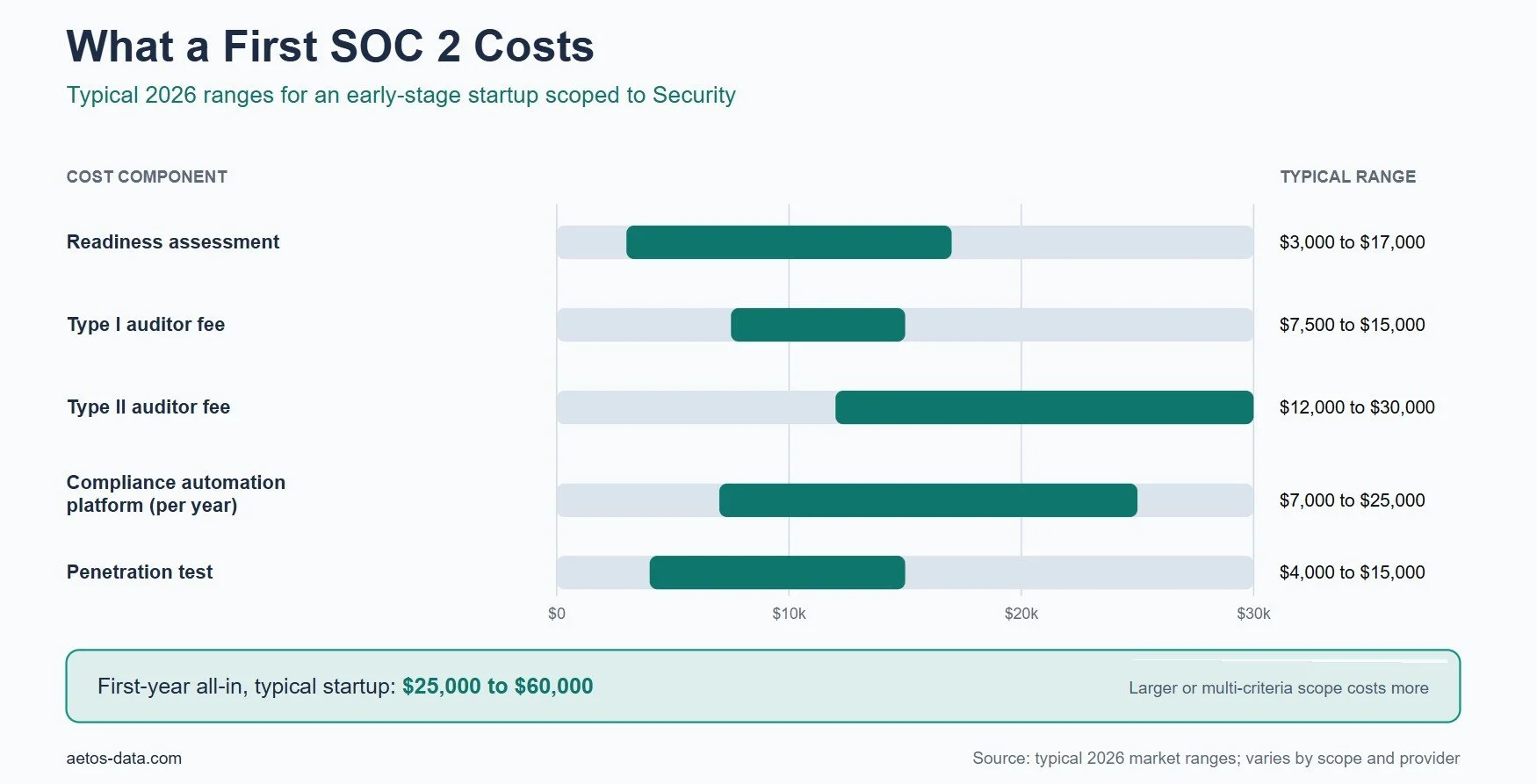
For a small SaaS company scoping to the Security criteria, here is a typical first-year breakdown. Treat these as planning ranges, not quotes, because scope and provider change the numbers.
| Cost component | Typical 2026 range | Notes |
|---|---|---|
| Readiness assessment | $3,000 to $17,000 | Gap analysis before the formal audit |
| Type I auditor fee | $7,500 to $15,000 | Point-in-time report |
| Type II auditor fee | $12,000 to $30,000 | Higher with more criteria or larger scope |
| Compliance automation platform | $7,000 to $25,000 per year | Evidence collection and monitoring |
| Penetration test | $4,000 to $15,000 | Often expected by buyers |
| Internal time and remediation | Varies | Engineering and security hours |
| First-year all-in (typical startup) | $25,000 to $60,000 | More for larger or multi-criteria scope |
Scope and size are the biggest cost drivers
A handful of factors move the price more than anything else:
- Number of Trust Services Criteria — scoping to Security alone keeps costs down; adding Availability, Confidentiality, Processing Integrity, or Privacy broadens and lengthens the audit
- Company size — more systems, more people, and more vendors mean more to examine
- Choice of auditor — large national firms charge more than specialized boutique firms sized to your stage
- Control maturity — how much remediation you will pay for depends on where your controls stand today
The timeline runs about three to six months
Most growing SaaS companies can be audit-ready in 8 to 12 weeks with the right guidance, then the report timeline depends on the type.
| Phase | Typical duration | What happens |
|---|---|---|
| Readiness and remediation | 8 to 12 weeks | Scope, document, and close gaps |
| Type I report | Shortly after readiness | Point-in-time examination |
| Type II observation window | Three to six months | Controls operate and are monitored |
| Type II fieldwork and report | A few weeks | Auditor tests and issues the report |
From kickoff to a Type II report in hand, plan for roughly six to nine months. Starting before a buyer demands it keeps you from negotiating against the clock.
Budget your team's hours, not just the dollars
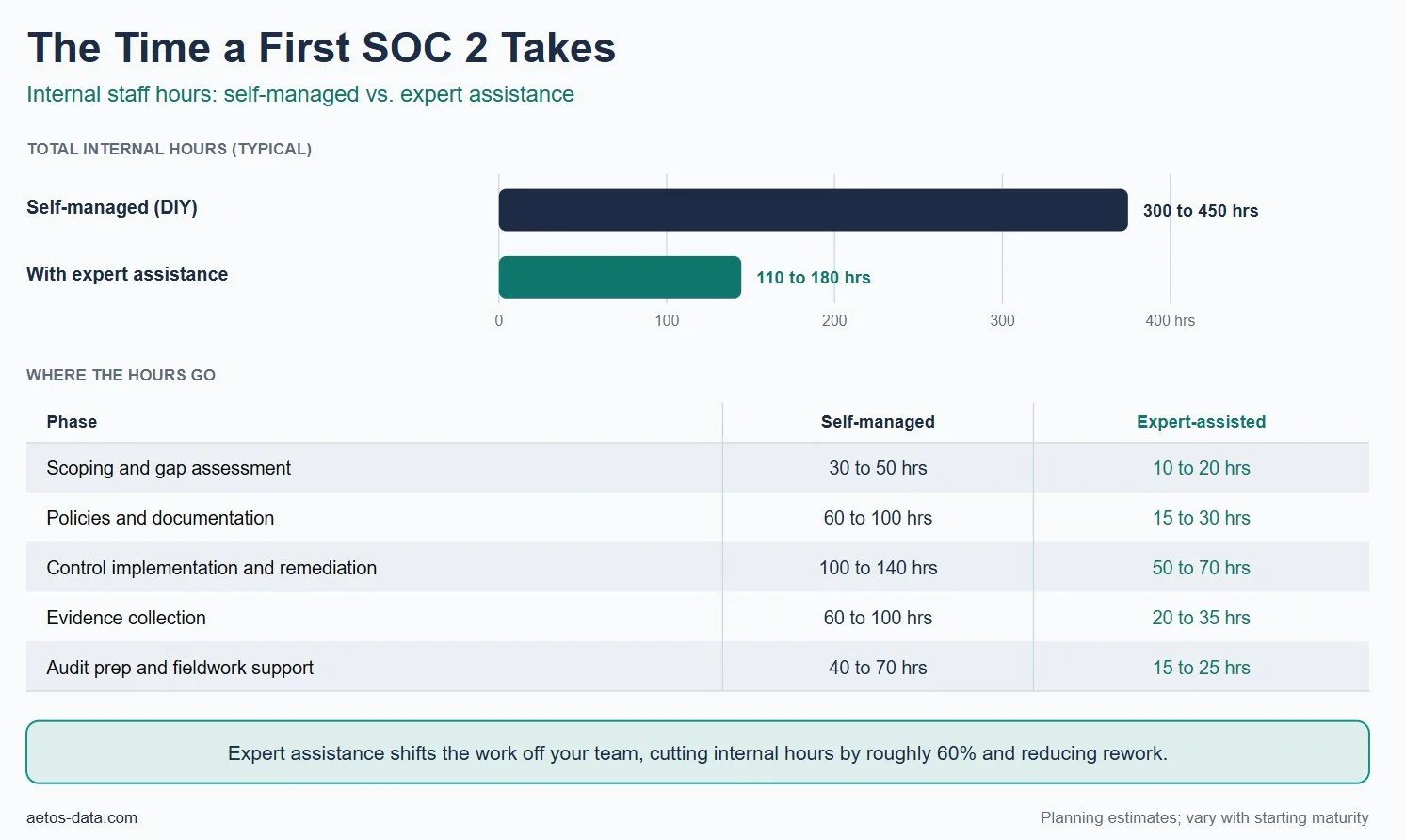
The cost that surprises founders most is not on any invoice: it is the time your own team spends. A first SOC 2 commonly takes roughly 300 to 450 internal hours when a team tackles it without prior experience, the equivalent of two to three months of a full-time person, usually spread part-time across engineering and operations. Much of that goes to research, false starts, and rework. With expert assistance and automation, internal time typically drops to about 110 to 180 hours, because the heavy lifting shifts off your team and rework largely disappears. The estimates below are planning figures and vary with your starting maturity.
| Phase | Self-managed (internal hours) | With expert assistance |
|---|---|---|
| Scoping and gap assessment | 30 to 50 | 10 to 20 |
| Policies and documentation | 60 to 100 | 15 to 30 |
| Control implementation and remediation | 100 to 140 | 50 to 70 |
| Evidence collection | 60 to 100 | 20 to 35 |
| Audit prep and fieldwork support | 40 to 70 | 15 to 25 |
| Total internal hours | ~300 to 450 | ~110 to 180 |
Those self-managed hours are usually senior engineering hours — the most expensive and scarcest time in a startup. That is why the timeline matters as much as the price tag: every hour your team spends learning the framework is an hour it is not building product.
Costs drop after the first year
The first year is the most expensive because that is when you build the program. In following years, the work shifts from building to maintaining, so renewal costs are typically lower. Your automation platform renews, the auditor examines a fresh observation window, and remediation is usually lighter because the foundation is already in place.
Budgeting SOC 2 as an annual program rather than a one-time project gives you a more accurate picture and avoids the impression that costs are spiraling when they are simply recurring.
How to keep the investment right-sized
You have real control over the total. Here is the sequence that keeps the program proportional to where your company is today:
- Scope to the Security criteria first; add others only when a buyer requires them
- Use a compliance automation platform to cut the hours your team spends gathering evidence
- Run a readiness assessment so you fix gaps before the auditor finds them — the most efficient sequence
- Choose an auditor sized to your stage rather than defaulting to the largest national firm
The return is measured in unblocked deals
The most useful way to weigh the cost is against what it unlocks. A SOC 2 report is what lets an enterprise security team approve you instead of stalling the deal, and it can replace lengthy questionnaires that otherwise consume weeks of your team's time. When a single enterprise contract is worth more than the entire program, the report pays for itself on the first deal it closes.
That is why a strong security posture is best understood as a sales asset, not a cost center.
Frequently Asked Questions
Where to go from here
The clearest way to budget is to model your own numbers rather than rely on averages. Try our What Compliance Really Costs calculator to estimate your investment, and read our explainers on what SOC 2 is and the difference between Type I and Type II and choosing between SOC 2 and ISO 27001. For the bigger picture, see investor-ready compliance for tech startups and how much AI compliance consulting costs.